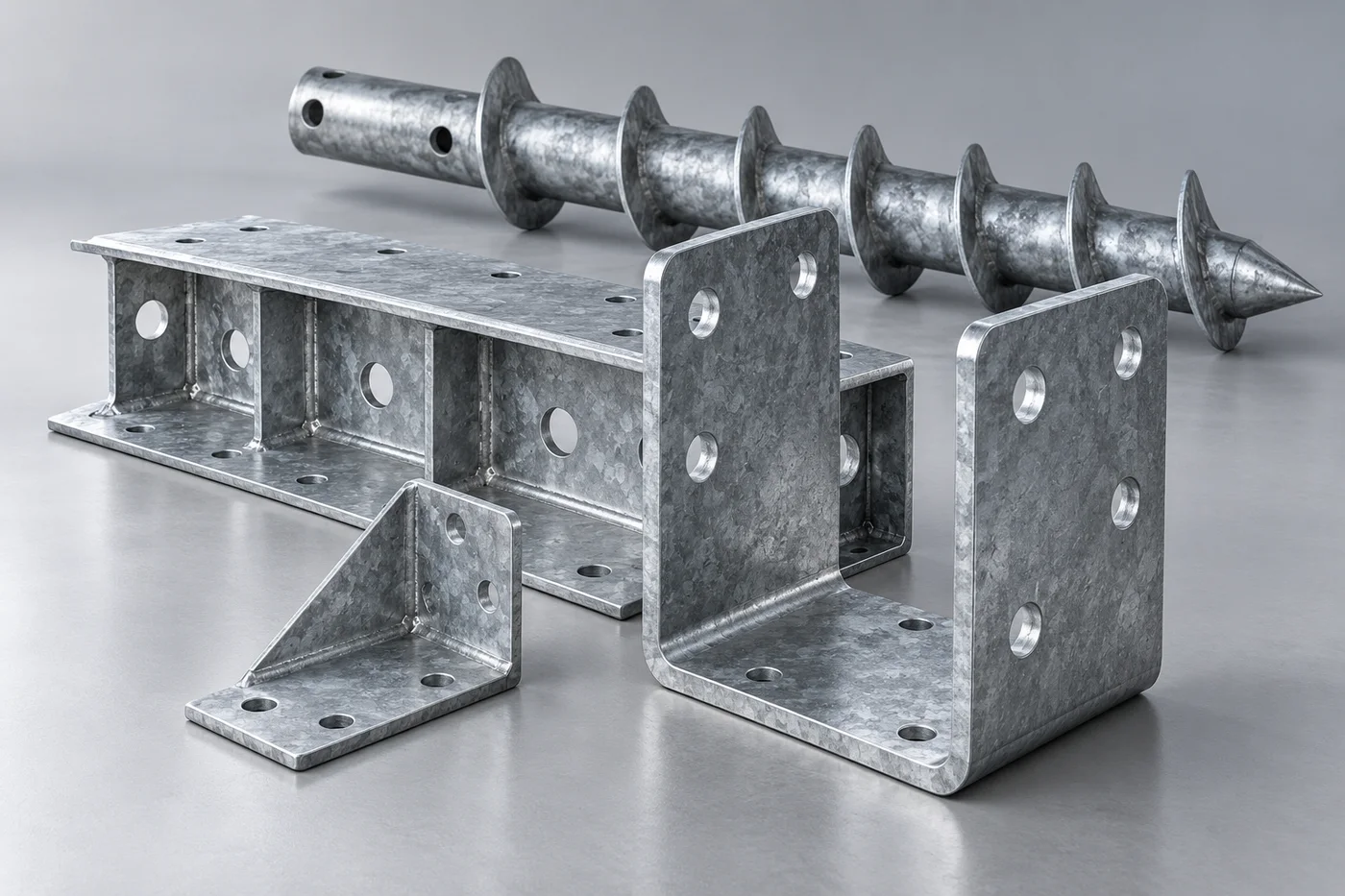
Mounting brackets, formed channels and connection plates for roof, ground and carport work. RIBSPAN supplies the steel parts in your system. The structural design stays with your engineer.
Illustrative product rendering. Not a production drawing.
Solar enquiries are still formed-steel enquiries, with three extra interfaces: the module or rail they clamp to, the structure they land on, and the weather they sit in for years. A bracket that is dimensionally correct and corrosively wrong is a failed part.
Tell us which interface is already fixed. If the rail section, purlin size or module frame is chosen, the holes and the fold have to follow it. If nothing is chosen yet, we can review a concept, but we cannot freeze a price or a coating until those interfaces exist.
Parts this family usually covers
Roof feetFormed hooks, feet and base plates that land on a stated roof member.
Rail hardwareSplices, end plates and brackets that match a named rail section.
Ground linksPlates and cleats between a rail, a column, a pile head or a foundation bolt.
Carport nodesConnection plates and folded seats at beams, posts and bracing.
Small kitsA bracket plus its specified fasteners, packed as one installation set.
Write the exposure before the colour.
Coastal sites, industrial roofs and dry inland fields do not share a finish.
What to name
Distance to the coast if it matters, any chemical exposure, and whether the part is seen. Then name the coating system: hot-dip galvanizing, a zinc-coated substrate, powder, or stainless steel. Colour is a powder question, not a corrosion question.
Fasteners
Bolt grade, coating and whether stainless hardware meets carbon steel are part of the brief. A galvanized bracket with the wrong bolt is a site problem, not a packing problem. Include hardware only if you want it in the same shipment.
What we will not stamp
Wind load, snow load and pull-out from a roof sheet need the project design. A concept render on this page is not evidence that a bracket is rated for a region, a module or a building height.
FILES THAT HELP
The mounting sketch is not enough. The interfaces are.
The fastest solar briefs include the part drawing, the rail or purlin it meets, the bolt list, the finish, the quantity per megawatt or per row if that is how you buy, and the destination. If the project is still at tender, say so. A budgetary range can be discussed, and it should be labelled as budgetary.
If you have an existing bracket that fails in the field, send the failure note with the drawing: white rust, hole elongation, a fold cracking at the radius, or a clamp that does not reach the frame. That tells the process review where to look. It is not, by itself, a new design.
Questions the quotation should answer
InterfacesWhich rail, frame, purlin or bolt circle the part is built around.
FinishThe coating route and any standard you require it to follow.
Quantity breakSample, first project, and the next quantity if the design repeats.
MarkingHow installers will tell left, right, row and revision apart on site.
PackingCartons an installer can carry, or bundles for a container. State which.
Before the mounting part is ordered.
Do you design a full mounting system?
No. We coordinate fabrication of the steel components in a system you, or your engineer, define. Layout, loads and structural sign-off are outside this supply scope.
Can one bracket serve every roof?
Only if every roof presents the same member, the same clamp reach and the same fastener. Send the roof build-up. A universal claim is usually a missing dimension.
Is stainless always the coastal answer?
Not always, and not automatically. Some coastal specifications use a stated galvanizing system; some isolate stainless fasteners from coated carbon steel. Follow the project specification, and write that choice into the order.
Can you quote from a module datasheet alone?
A datasheet gives frame depth and a few hole clues. It does not define the rail, the roof member or the bracket. Those still have to be drawn or sampled.