CUT. FOLD. CONNECT.
Formed brackets
Cleats, connection plates, angles and small folded parts. The hole pattern, bend and mating face decide whether the part fits the assembly.
Specification notes
PRODUCTS
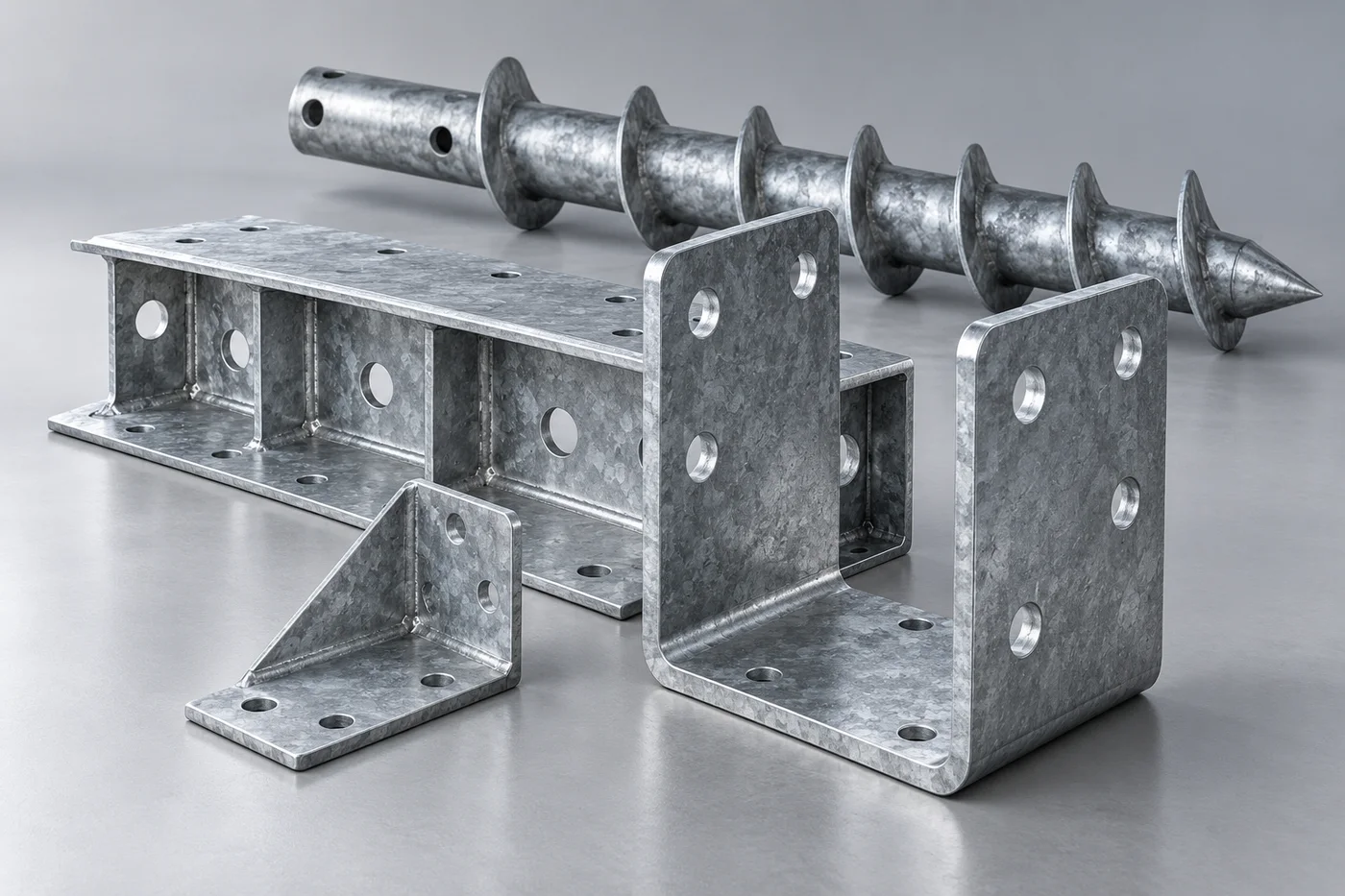
Four component families cover most drawing-based steel enquiries. The family only organises the conversation. Material, finish, tolerance and quantity still come from your drawing.
CUT. FOLD. CONNECT.
Cleats, connection plates, angles and small folded parts. The hole pattern, bend and mating face decide whether the part fits the assembly.
Specification notesSOLAR MOUNTING COMPONENTS
Brackets, formed channels and plates that connect a mounting system you already have in mind. We do not assign a wind or snow load from a picture.
Specification notesGROUND FOUNDATION COMPONENTS
Shafts, helical plates, heads and extensions made to a foundation design. Capacity stays with the project engineer and the ground report.
Specification notesDRAWING-BASED FABRICATION
Welded assemblies, kits and geometry that does not sit in a catalogue. Quotation starts from PDF, DXF, DWG, STEP or a measured sample.
Specification notesHOW TO CHOOSE
Use formed brackets when the part is a connector: it locates two members, carries a hole pattern, and is mostly cut and folded. Use solar components when the same kind of part has to meet a rail, a module frame or a roof interface. Use screw piles only when the part goes into the ground and a foundation design already exists, or is being prepared. Use custom fabrication when the part is an assembly, a weldment, or a shape that needs a process review before anyone can price it.
If a project mixes families, send them as one brief and mark which lines are loose parts and which lines are assemblies. Mixed carts are normal. What slows a quotation is a missing revision, a missing unit, or a finish described only as “galvanized”.
These pages explain what to specify. They do not approve a structure, a foundation or a coating life.
Critical dimensions, hole positions, bend direction and weld symbols belong on the drawing. A render on this website is only a way to recognise the family.
Load, deflection and pile capacity need the project engineer’s inputs. RIBSPAN will not confirm them from a product image.
Mill documents, coating checks and inspection records are agreed per order, for the factory and the scope actually selected.
PROJECT BRIEF